Showing posts with label tutorial. Show all posts

Our Stock Tank Pool: Part I

>> Monday, June 4, 2018

You may remember the pool we set up last year in the backyard. It was absolutely perfect. Around 7.5 feet by 9.5 feet and just around 2 feet deep. The kids had so much fun splashing around all summer in those 870 gallons of H2O. The setup worked well, and it was relatively inexpensive. If you're interested, I would highly recommend these Bestway pools as a first step into learning how to care for a pool.

But we had a mouse issue in the fall and they got to the pool. So, we needed a solution for this year . . . and hopefully for many years to come. I've seen so many articles about stock tank pools crop up in recent years. I was always too intimidated by the process of getting a huge galvanized tub to my house, so it was on the back burner.

This year, we decided to pull the trigger.


For those of you who have been asking me questions (and there are many of you!): We picked up our 8 foot stock tank at Tractor Supply. It's 24 inches deep. Our store does not do delivery, so we asked a friend to help us get it home. It wasn't too bad a process -- aside from one roadside adjustment -- and ended up being much easier than we anticipated. When we got it home, we gave it a good scrub because the store had been displaying plants inside it.

From there, it was all about re-leveling the area we had dug out last year.


Surprisingly, it took a few hours to get the area absolutely perfect. Last year, we settled with level-ish. But one benefit of getting this type of pool is that you can leave it out all year. We're hoping to leave it in place, so taking our time was in our best interest.

When that was done, we put it where we want it to go and got to work on the landscaping. Mostly rocks that we bought at the store and pulled up from the creek area behind our house.


I love how it looks! So much prettier than the bold blue with white supports from last year.


This stock tank holds around 700 gallons of water, so it is smaller than last year's. I had to buy a new filter pump that we are going to drill/hook up tonight. That will be part II of my posting. But if you're interested in doing a similar project at your home, I highly suggest checking out the number of really helpful tutorials I found online.

Here are some of my favorites:

DIY Stock Tank Pool: Everything You Need to Know
How to Make a Stock Tank Pool
Stock Tank Swimming Pool Ideas

Just a budget breakdown. We ended up getting the tank for $349 plus tax at the store. They're usually $399, but we got it on a Memorial Day sale. The new filter we bought was $35 on Amazon. The rock was around $30 because we already had some leftover from last year. It's not the least expensive upgrade we could have done, but I am hoping it will pay off in the long run.

Why didn't we go with a larger option? Well, partially because we didn't want to eat up our yard with a pool the whole year. Or have a big hole when it's cold outside. I like that it's shallow enough that Eloise's head is well above the water. But yet it's big enough to still get in as an adult and cool down. It looks nice, though I understand the style isn't for everyone. And we are hoping that the galvanized steel is durable and lasts for many years.


If you have further questions, I'd be happy to answer them either in the comments or on Instagram!

I'm going to do another post once we get it up and running to talk about any issues we run into or any tips I have. But I won't be writing out a full tutorial. Again, I highly recommend the links I provided above. We're learning as we go.

Happy Monday!

Read more...

Our Hand-Painted Backsplash

>> Tuesday, September 20, 2016

This is one of my favorite DIY projects. So, I'm re-posting it for those of you who might be interested in doing the same thing in your home. I'll hopefully get an updated kitchen tour up soon, too. We have done a lot more since two years ago!

I mentioned in my last kitchen post that I was thinking of jazzing up our tiles with some painted designs. And after we started getting up all the white doors, the white tile was looking rather plain and ordinary.

First, let’s take a look at where we started.


And in progress:


Let me back up. Our tile backsplash was painted white by the previous owners. It was plain Jane. I knew eventually we’d want to liven it up. And when was browsing around, I found all these cool Moroccan-inspired tile prints. I liked the ones most where they’d mix and match the tiles for a crazy sort of look. And since I like taking risks, I figured a few tubes of craft paint and hours of my time would be worth the experiment. If I totally hated it, I thought, I could always just cover it over with metal backsplash like we did in our previous kitchen.

So, I started. And immediately I thought I made a mistake.


Several hours of work -- and over 130 tiles later -- it really came together. At least in my opinion. I think once I can get full kitchen makeover photos up, it’ll look even better. All the clutter and crap is just out of frame in these photos, but the impact the print has on the room with tying together all the colors is big.

And with so many patterns together, you can’t tell quite as well that I’m not at all an artist. At all. Instead, it’s a beautiful chaos.


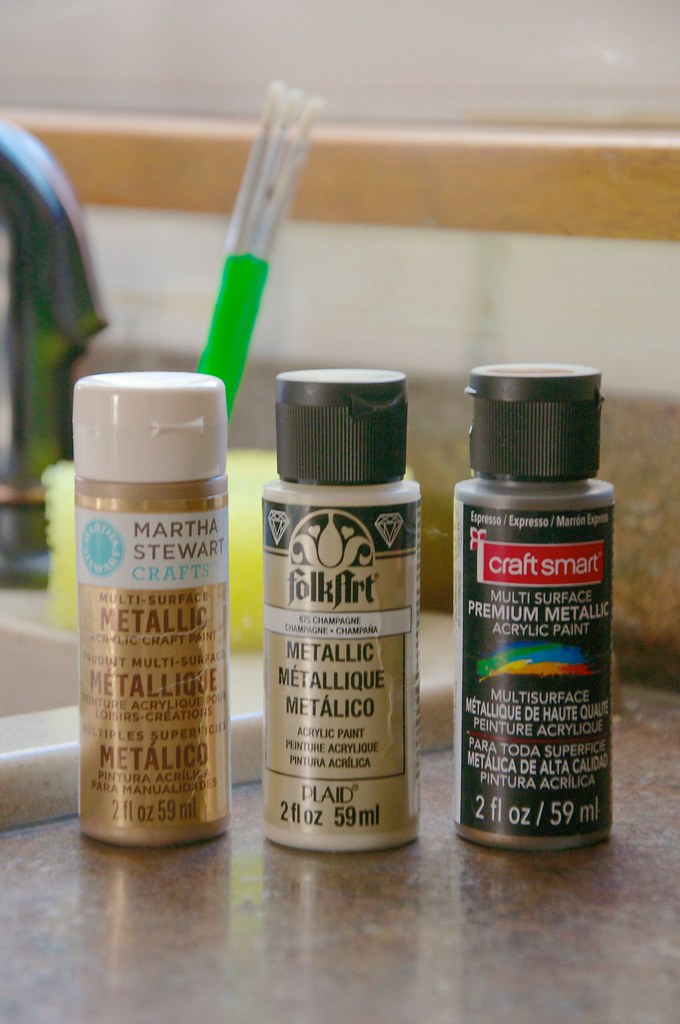
I started by copying a few of the prints I liked on this backsplash, but soon decided to go rogue and create my own. I used the following metallic craft paints (paint + brushes cost less than $10 for this project) -- one in a color that went with the trim, another with the counters, and the other with the cabinets. I would have loved to do bright, vibrant colors -- but since the counters and sink are earthy tones, I didn’t think it would go as well.

I tried three different brands of paint and you really do get what you pay for. The Martha Stewart Paint colors were the best, it was the easiest to work with. The Folk Art and Craft Smart was kind of runny. But they all did just fine in the long run. I think after I let them dry fully, I’ll probably cover with some clear topcoat for extra durability.


I know this look isn’t for everyone.

It’s fun, though, and fit well within our budget.


Looking forward to sharing more of the transformation. Initially, I know that our ultimate goal has been achieved -- the white cabinets make the space a lot brighter despite the lack of windows in the room. That’s the biggest help! The fun tile is just the icing on the cake.

What risks have you taken with your home decor?

Like what you just read? Browse more of our posts + recipes on Pinterest. Chat with us on Twitter or Facebook. And you can always email us with your questions and comments.

Read more...

Homesteading: Natural Vapor Rub

>> Tuesday, October 21, 2014

You may have noticed that I started writing about essential oils much more frequently in recent months. They’re something that’s always sort of been in my arsenal of home stuff, but the way I use them has broadened much beyond simple defusing. Now, I haven’t gotten into consuming essential oils or learning the specific combinations for medicinal purposes, but I’m slowly educating myself.

Like anything that’s slanted toward the natural -- I’d rather try home remedies and comforts than the store-purchased alternative. It’s also pretty cool when I discover something that actually soothes me. Empowering, I guess. (Note: I gladly take the Z-pack when I get mega-sick. Thank you, modern medicine!)

Though, I’m pretty sure Veggie Pho cures all!


So, along with slowly learning to make my own baking soda deodorant and soft skin lotion cubes, I’ve been venturing deeper into other DIY skincare territory. This time, of a more medicinal nature. I’m a huge fan of vapor rubs for cough and cold. I figured -- like everything else -- this was the kind of thing I could whip up in my own kitchen. And I was right.

There are lots of recipes on the web. Here are just a few.
Of all recipes, I favor the simple beeswax with oil and essential oil combination. I know a popular cure-all blend is Thieves, which was apparently used by these French guys who robbed people during the Plague. At least that sounds mysterious and probably moves oil. Regardless, it’s hailed for fighting germs and helping with chest congestion, etc. The major oils in it are cloves, rosemary, eucalyptus, lemon, cinnamon -- if you’d like to make your own to use in place of the oils in my recipe, go ahead!

I decided to go with two that I already own -- eucalyptus and peppermint -- because they are the stars of my favorite Badger Balm (Breathe Easy). And what’s awesome is that the balm this recipe makes is almost identical in texture and scent, just for a fraction of the price.


DIY VAPOR RUB
Use the smaller essential oil amounts for a baby + kid-strength variety.

What you’ll need . . .
Method . . .
  1. Combine your carrier oil and beeswax in a small, heat-safe bowl. Heat a small pot of hot water on the stovetop and then place your bowl inside to let everything melt together. Mix.
  2. Then take off heat and add your essential oils. Mix.
  3. Pour into a glass container for storage and place in the fridge to harden quickly. You don’t need to store it in there, though. I was just impatient and wanted it to quickly firm up.

I rub this stuff on my chest when I have coughs. I let it linger on my throat when it’s sore. I slather it under my nose when it’s stuffy. I even do that trick of putting it on Ada’s feet when she’s under the weather. At very least, it’s comforting and does provide at least some relief, in my humble opinion and experience.

Have you ever made a balm like this one? 

What’s your favorite combination of ingredients? 

Whenever it comes to homemade stuff, I like to stick to as few ingredients as possible. It keeps the cost down and keeps it simple + easy to remember. I’m also trying to learn more about the use of essential oils during pregnancy. Though I’m not pregnant yet, most of the bottles of oils I have say not to use (or to consult with a physician) if you’re pregnant. Do any of you know more on that topic?

And speaking of homesteading stuff, I also mixed together another 5 gallons of DIY Laundry Detergent today! Now that we’ve moved, it’s working so much better with our new water (it’s a bit harder -- so, go figure!). Instead of the ratio of 1/2 cup borax to 1 cup washing soda, I did 1:1, so I’ll be sure to let you know if it improves or hinders the power.

Like what you just read? You can subscribe to the feed of these posts or follow us on Twitter or Facebook to be the first to know what the (never home)makers are up to. And we’ll love you forever!

Read more...

Have Fun. Make Stuff. Yourself.

>> Thursday, October 27, 2011

We haven't written about many of our crafty projects in a while. It's not that we're not making stuff. I guess we're just being quiet about it! But in the spirit of all things doing-it-yourself, we thought we're recap some of our favorite tutorials for you!

DIY LIGHT BOX

Now that the sunlit hours are starting to dwindle, photographers out there might enjoy this tutorial on how to make your own light box. It's a cheap, easy way to get better photos indoor during the winter months.


RECYCLED T HOLIDAY GARLAND

The holidays are on our minds a bit early this year since decking the hall in our house might take some extra preparation. This festive garland is made from recycling t-shirts. New sewing or other crafty skills are required!


YOUR OWN WORT CHILLER

Beer enthusiasts might enjoy our entire series (go to the "Home Brewing" section) on how to make your own beer. This particular tutorial covers this lovely piece of equipment that's critical to the process.


CRAFTASTIC ENVELOPES

Snail mail isn't out of style -- especially if you jazz it up with fun details like these homemade envelopes. You can use any kind of paper or card stock. And they're fun for sending invitations to parties and other events.


PRETTY (EASY) ETERNITY SCARF

I'm not exactly a pro-knitter. But even I can handle this project! Just in time for the chilly weather, you can make your own eternity scarf . . . and it's much easier than you might think!


And today on (never home)maker, baby! we're asking experienced parents to help us out. Will having a baby be the end of, well, US as we know it? We're starting to freak out.

Like what you just read? You can subscribe to the feed of these posts or follow us on Twitter or Facebook to be the first to know what the (never home)makers are up to. And we’ll love you forever!!

Read more...

How to Build A Light Box: Photography

>> Wednesday, November 10, 2010


As I mentioned yesterday, Stephen and I built a light box (mini-studio) over the weekend. We're hoping it allows us to take better photos in the dark hours (which are now abundant). Plus, it's just fun to play around -- we're relatively new to serious photography.

The benefit of building your own light box is that . . . you no longer need the sun to take an adequate photo. By carefully positioning three lights (with daylight bulbs -- producing a nice, cool tone) and bouncing light off fabric, you can eliminate many shadows from your shots. I get a lot of rejections from Tastespotting and Foodgawker for lighting/shadows. It makes me sad.

Uh -- hello! I work full-time. So, most of my photography has been done at weird lighting hours. I know many of you are in the same dismal situation.

Anyway, though I enjoy this light box, it doesn't substitute for natural light. But it helps. And I think after a couple weeks with it, I'll have more tips on how to get the best photos possible. At least I hope!


STEP 1: GATHER YOUR MATERIALS

You'll need . . .

  • A cardboard box (larger than 12" x 12" -- mine's 18")
  • Duct Tape (we used both the silver and white)
  • White tissue paper or fabric (we used a cloth shower curtain liner)
  • Velcro (optional, we'll explain below)
  • Daylight bulbs -- 100 watt
  • Box cutter
  • 3 cheap-o utility lamps w/ clamp bottoms (as shown -- we bought the medium size)
  • Fabric or paper background/backdrop (we'll explain below)
  • 3-outlet extension cord (optional)


Total cost: Approx $35 (but you can do it for less than $20 -- we overspent)


STEP 2: PREPARE YOUR BOX

Take your cardboard box and tape the back of it so it's closed on one end. Then, you're going to take your box cutter and cut out windows from three sides of the box (the right, left, and top). Leave the bottom as-is.


We left about 2 inches of a border for support. If that makes any sense. (For a lot of these instructions, it's just easier to look at our light box. Kind of hard to explain).


Have fun with the box. This process takes at least an hour (or two), so you need to do something to make yourself laugh a bit.


We also framed ours out with duct-tape. I don't think this step is necessary. We thought it would provide extra support . . . but it didn't make much of a difference.

Seriously! Don't waste your time!


STEP 3: TAPE ON YOUR TISSUE PAPER OR FABRIC

Cut panels of white cloth/tissue paper that will cover each of your open windows you cut out. We got fancy and started to velcro each panel on. This was so totally not worth it. Simply tape your white material over each of your open windows.

It's that easy.


We used a polyester bath curtain liner for this part. We thought it would be the best material for bouncing light. Maybe. Maybe not. It was annoying to have to iron it before putting it on the box. I've read many different places that white tissue paper works just fine.

Plus, tissue paper costs mere pennies. The liner was $10.


STEP 4: HANG A BACKDROP, LAY A "FLOOR"

I used some Velcro (prickly side) on the very back on the box . . . and then put a line of Velcro (soft side) on several different swatches of fabric (that are as wide as the box and at least as long as the box). Too, I laid a bamboo table runner on the bottom of the box to create an interesting floor for my shots. You can also just lay more white fabric . . . or use a long piece of fabric and drape it from your Velcro anchor coming toward you.

Admittedly, mine looks a bit sloppy. But you don't need it to be perfect because you'll frame out all the bad stuff in your photos.


STEP 5: LIGHTS, CAMERA, ACTION!

You'll want one of your lights (I believe ours are 8" in diameter) shining through each of your windows. The white fabric diffuses the light, making it soft and perfect for taking bright photos with little shadow.


We still haven't found a permanent space for our light box, so we clamped our lights onto chairs. ANYTHING we could find to get them zeroed in on the right spot.

STEP 6: TAKE LOTS OF PHOTOS. EXPERIMENT AND HAVE FUN!

Here are some of the first shots I took:


SOURCES:

If you're wondering where I learned to build this thing . . . I seriously consulted just about EVERY single page I could find. Just Google (or even search in YouTube) "how to build a cheap light box" or "photography light box DIY" or something similar. There are all different methods. Find what's right for you and your budget.

And if you'd like to just have one magically appear, you can order them. I've seen prices starting at $59 . . . all the way up to $1,200.

Whatever the case may be, it's a whole lot better than my other solution:


Questions? Comments? Suggestions? We'd love to hear 'em. Just leave us a note below or email us at neverhomemaker [at] gmail [dot] com.

Like what you just read? You can subscribe to the feed of these posts or follow us on Twitter or Facebook to be the first to know what the (never home)makers are up to. And we’ll love you forever!

Read more...

Eternity Scarf Tutorial

>> Thursday, February 11, 2010


I've said it before, and I'll say it again: I'm no fantastically talented knitter. The most impressive project I've completed is a pillowcase. And that not really that impressive. So, if you have two hands, basic knitting skills (know how to cast on, cast off, and knit a basic stitch), and some motivation . . . this project is totally for you.


What's so mystical about an eternity scarf? Nothing. Seriously. The "trick" is that you knit a scarf . . . and then sew it together. That's it. But I'll cover some basic knitting techniques for those of you new to the craft. (And for those of you who have no idea why I'm sharing this project -- it's because I featured my handmade creation in my latest style post: Personalize Your Style the Homespun Way.)


Step 1: Clear the area of any cats. As you'll see in my photos. I do not follow this crucial step as I begin work on yet another eternity scarf to add to my collection. But it makes for some fun photos.


Step 2: Gather Your Supplies.
  • You'll need knitting needles (I recommend size 13, 9mm -- bamboo or metal or plastic, doesn't really make a difference);
  • 2 skeins of some good medium to chunky weight yarn (I got mine at a local joint, but didn't save the wrapper. It's 100% wool, hand-dyed. The nicer the yarn, the nicer the scarf -- but if you're new to knitting, you might want to get some cheaper stuff to practice with first.);
  • and a yarn darner is helpful (it's a big needle that you'll use to sew the two ends of the scarf together . . . but I didn't use one. I just used my fingers). 

Step 3: Cast on. If you're a visual learner, check out these step-by-step instructions -- with photos -- on how to cast on using two needles. You can also cast on with just one, as you can view in this YouTube tutorial that got rave reviews. Personally, I like the two-needle approach. But you have to do what's best for you. Anyway, cast on around 15 stitches, depending on the weight of your yarn.


Step 4: Knit away. I didn't use any fancy stitching to make my scarf. Just the basic knit stitch. If you're unfamiliar with how to do it, just view this helpful (and illustrated) tutorial. It covers both the knit and purl stitches. Despite even the best tutorials online, I have always found it helpful to ask others who knit how to do stuff. So, I'm sure you know SOMEone who knits. And that SOMEone should be willing to help you if you're confused :) Once you get the hang of it . . . it's easy. So, knit away until your scarf is long enough for you to stretch it fingertip to fingertip across your chest (or between 5 and 6 feet long).


Step 5: Cast off.  Again, this helpful (and illustrated) tutorial can give you all the tips you need, and if you're more into video, check out this great video. Once you're totally cast off and cut the umbilical cord . . . you can continue to the final step!


Step 6: Sew it up. Congrats! The "hard" part is over. Now, this is where the yarn darner comes in handy. Make a big loop with your scarf . . . and then hold the two ends together and use some leftover yarn to sew them together with a basic whipstitch (Uhm, when I say "whipstitch" it makes me feel like I'm all hardcore, like Christina from Grey's Anatomy -- sewing up people, not scarves -- photo from ABC). If you'd like to be EXTRA anal (like me), instead of it just being a whipstitch, you can also tie off each time you stitch so there's a little knot. It's hard to explain, but when you're looping around, tie the loop so it's secure and continue to your next stitch. This might not sound very technical . . . but whatever you can do to bind the two ends together securely is FINE.

And that's how you make this season's most stylish accessory -- the all-by-you, super-duper-handmade, homespun way. Feels good, right? Looks even better (the scarf, not me!) . . .


And if you're a veteran knitter with some tips and tricks to share with us all -- PLEASE DO. I'd love to hear from you, so either leave a comment or email us at neverhomemaker@gmail.com. Also. Today's your last day to enter our giveaway of Martha Stewart's Cooking School cookbook. The lucky winner will be announced tomorrow AM.


Like what you just read? You can subscribe to the feed of these posts or follow us on Twitter or Facebook to be the first to know what the (never home)makers are up to. And we’ll love you forever!

Read more...
Related Posts Plugin for WordPress, Blogger...

About This Blog

MyFreeCopyright.com Registered & Protected

© 2009-2014 by the (never home)makers
All content on this blog is copyrighted.

Want to publish our pics, tips, or tricks?
Contact us! [neverhomemaker@gmail.com]

We value transparency. Links on this page may contain affiliates. In addition, please see our disclosure policy regarding sponsored posts.

  © Blogger template Simple n' Sweet by Ourblogtemplates.com 2009

Back to TOP  

Blogging tips